

The Terrible Tories
How well do you think Tories handle crises?

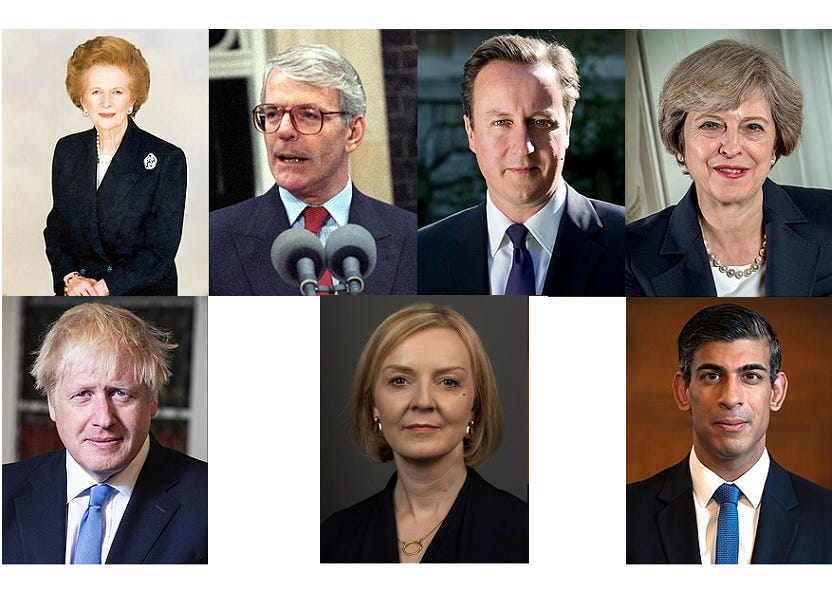
Thom Hartmann (disclosure - I produce his newsletter) recently wrote a fascinating article, "Why It's Impossible for Right-Wing Governments to Handle a Crisis", in which he gives examples from around the world and going back as far as Nixon and his tax cuts in the United States, though you could go back further. He explains how 'right wing crises face incompetence or cynical exploitation'. It's certainly true in the current American race for the speakership of the house, and has been true of the battles to become Prime Minister of Britain. I thought I'd take stock of how the Tories have handled - and created - crises over the past 13 years.
Nixon, of course, is famous for his treason to obtain the presidency, his Watergate scandal and his racist Southern strategy. He wasn't above taking bribes, either.
Some of the examples below do not directly impact ordinary people, but they've done great harm by reducing the peoples' trust of government, which makes dealing with crises harder. Some Tories have done some good things for the people, unlike Republicans, but in this article I'll focus on what they have done which fits in with the theme of their inability to handle crises. They seem to be quite good at creating crises, though.
When it comes to that great source of crises, economic policy, Thom is fond of saying, "it all began with Reagan". I disagree. Maggie Thatcher took office getting on for two years before Reagan.
Maggie Thatcher (Jan. 20, 1981 – Jan. 20, 1989)
Thatcher's deregulation favoured business over the people (later, deregulation in the U.S. was to cause the crash of 2008 which affected much of the world). Her remedy for the Winter of Discontent just before she took office was to crack down hard on unions, particularly in the miners' strike of 1984–85, thereby reducing the power of the people but doing nothing about the sources of discontent. She called trade unions the enemy within.
She did handle the invasion of the Falklands by Argentina decisively, which gave her a boost in popularity. This encouraged Reagan to invade Grenada and George W Bush to invade Iraq, the latter causing the deaths of tens of thousands of people, Americans and Iraqis.
She was also good at creating crises, particularly by privatizing the commons. We are feeling the effects now, with water companies paying themselves massive bonuses and dividends while regularly dumping sewage in our rivers and oceans, doing very poorly at fixing leaks, and failing to build any reservoirs to meet increasing demand as droughts are becoming more likely. Electricity prices have gone through the roof since the Ukraine war, unlike those of may European countries whose utilities are state owned.
She did not bring peace to Northern Ireland, and narrowly escaped an assassination attempt by the IRA.
John Major (28 Nov. 1990 – 2 May 1997)
John Major privatised British Rail and the coal industry. Train services are now very expensive and very inefficient. Black Wednesday occurred on his watch, when sterling had to be withdrawn from the European Exchange Rate Mechanism. Though opinions differ on whether that was a good or bad thing, it did nothing for Britain's reputation and cost Britain £3.3 billion.
David Cameron (11 May 2010 – 13 July 2016)
Inheriting the consequences of the 2007–2008 financial crisis, Cameron imposed austerity on the country, beginning what to date has been 13 years of misery for the people. It is estimated that over 330,000 excess deaths in Great Britain were linked to austerity, as of a year ago.
His policy on Libya has been condemned - it lead to a rise in ISIL.
It was he who instigated a referendum on Brexit, although a remainer himself, leading to a loss of freedom for the British people, increased bureaucracy and cost for British businesses, an opportunity for liars to enhance their power at the peoples' expense, and a major distraction, making conservative politicians even less able than usual to deal with governing the country and dividing the party as it did the country. He resigned after the referendum.
Although The Brexit vote was not binding and it was not by a wide margin and showed great regional disparity (so Brexit would be divisive, regionally), all Prime ministers since have acted as though it had a large mandate and must be enacted and not repealed, even if they were initially against it. It would appear that this would be to further their careers, not for the good of the country.
Theresa May (13 July 2016 – 24 July 2019)
Although a remainer, Theresa May began the process of withdrawing the UK from the EU. She then called a snap election hoping to strengthen her hand, but ended up with a hung parliament and having to cooperate with the DUP of Northern Ireland. Her government passed the European Union (Withdrawal) Act 2018. She survived two votes of no confidence but parliament rejected her draft Brexit agreement three times and she resigned.
She replaced many cabinet members with Brexit supporters, including Boris Johnson who was a disaster as Foreign Secretary. She wanted to leave the EU without giving parliament a vote. She apparently had no plan B for if there was no deal.
Her 2017 manifesto dropped a 2015 pledge not to raise income tax or National Insurance. It introduced what was called a "tax on dementia", saying the value of the property of people who needed care at home would be taken into account when calculating assistance with care.
An unprecedented number of MPs resigned under May, the majority because of Brexit.
When she was Home Secretary, May cut the police force by 18% (a loss of around 20,000 police officers). Manchester police warned her before the Manchester Arena bombing that the cuts would lead to an increased risk of terror attacks.
She continued the Tory squeeze on benefits.
She apparently ignored intelligence that Russia was interfering in elections, including Brexit - which meant that the majority may not have been in favour of Brexit at all. There was no assessment of the situation.
Boris Johnson (24 July 2019 – 6 September 2022)
Johnson was a major player in the Vote Leave campaign. One of his first actions on becoming Prime Minister was to illegally prorogue Parliament. After failing to win parliamentary support for his revised Brexit withdrawal agreement with the Northern Ireland Protocol, he called and won a snap election. Britain left the EU. There have been many downsides to this.
Johnson immediately dismissed 11 senior ministers and six resigned. He soon lost a working majority and 21 Tory MPs who disagreed with him over Brexit had the whip withdrawn (ten were later restored) and Amber Rudd resigned her post in protest, and his brother resigned as an MP. He called a general election and, like Trump, won on his personality and on promises that would be broken. He promptly sacked 5 more ministers and shuffled some around. So when COVID came along, we had many inexperienced ministers and a party that was focused on the totally unnecessary, and harmful, Brexit. He was also focused on his divorce, latest girlfriend, and new child on the way.
During the COVID-19 pandemic he got one thing right, being quick off the mark with vaccination (though he lied about that being a benefit of Brexit, and it was the NHS that did the work so well), but otherwise was slow to react. He missed the first five COBRA meetings. According to one senior Government adviser, “There’s no way you’re at war if your PM isn’t there... There was a real sense that he didn’t do urgent crisis planning."
Johnson was slow to order precautionary measures suggested by the Scientific Advisory Group for Emergencies (SAGE) and did not take precautions himself. He caught COVID and the UK's infection rate was higher than most. Johnson called long covid "bollocks" and allegedly said, 'Let the bodies pile high in their thousands' rather than order more lockdowns.
While imposing lockdowns and social restrictions on gatherings on the rest of the country, Tories ignored the rules themselves and partied, leading to a scandal called Partygate. The Metropolitan Police were slow to investigate (with policemen guarding entrances to No. 10 and other government buildings, they must surely have seen signs) but have issued some fines, including one fine to Boris Johnson. Other Tories who broke the rules were not punished. Johnson was in denial. The Commons Privileges Committee investigation into Boris Johnson found that he had lied to parliament.
By ignoring even their own rules they not only endangered others personally, they also reduced the likelihood of others taking due care too, though the police did impose sometimes large fines on people outside of Westminster who broke the rules, and most people showed more sense than the Tories did.
Johnson ‘misled parliament’ over Covid contracts. A Covid Inquiry is currently looking into how badly the government handled the pandemic.
Britain declined to join the EU in buying PPE. Instead, Tories awarded contracts for PPE and ventilators to their cronies, including Matt Hancock's pub landlord and Michelle Mone, who often had no relevant experience or resources. The result was big profits for their friends. Some orders were never filled and others failed to meet standards, resulting in major shortages in hospitals and care homes leading to excess deaths. Fraud was rampant. Matt Hancock ignored offers by qualified companies to provide PPE and denied there was a shortage. One broker made £17m. £8.7bn of pandemic PPE was written off.
A particularly tragic failure was the policy towards care homes, which was in stark contrast to the reassurances given by then health secretary Matt Hancock. The government allowed people to be discharged from hospitals to care homes without testing in the first weeks of the pandemic, and they were not isolated. This was later ruled illegal. Many elderly people died unnecessarily.
Matt Hancock chose Dido Harding to head an NHS COVID Test and Trace system, which turned out to be very expensive and very ineffective. It was also misnamed, as it was not run by the NHS but by private companies.
Epidemiologist Prof John Edmunds testified, "As I explained to Prime Minister Boris Johnson, we either lockdown now and control the epidemic, or it will force you into a lockdown later, when you'll have to lockdown harder and longer. 20,000-25,000 people died. Some would have, but there's no reason for that many people to have died at all. There was no strategy, no long-term thinking."
It is not uncommon for Tory MPs to have second jobs, including some which might produce a conflict of interest. When the lobbying by Owen Paterson became an issue, Johnson backed a motion to block his suspension.
While supporting Ukraine with foreign aid and weapons, and imposing sanctions on Russia, the Tories have received donations from people with links to Russia and made Russian-born media mogul Evgeny Lebedev a peer.
Once it became clear that Johnson was no longer able to win elections, his major asset, and as his party was rocked by scandal after scandal, he resigned, leaving the party focused on leadership elections when it should have been focused on crises, including the ongoing COVID pandemic, the war in Ukraine, the fallout from Brexit and the resultant economic woes.
Liz Truss (6 September 2022 – 25 October 2022)
Liz Truss only lasted around 50 days. She and the Chancellor of the Exchequer, Kwasi Kwarteng, introduced a mini-budget of unfunded tax cuts that tanked sterling, cost Britain £30 billion and increased peoples' mortgage rates during a cost of living crisis and put some pension funds at risk. They had not consulted interested parties. Much of it was reversed not long after. She became the most unpopular prime minister as well as the shortest-serving prime minister in British history, and resigned. She is unrepentant (oblivious?) and is proposing her own budget again.
Rishi Sunak (25 October 2022 - )
Rishi Sunak was one of those who got a fine for Partygate. While Sunak eventually appointed a new ethics adviser, he's toothless. Sunak supported Brexit. He was one of the first of the mass resignations that led to Boris Johnson's resignation. He was one of the hedge fund managers who triggered the 2008 financial crash.
Considerable concern has been raised about conflict of interest issues arising from the financial dealings of his wealthy wife, Indian heiress Akshata Murty. His Future Fund invested nearly £2m in firms linked to Murty. Labour has asked the watchdog to investigate. She is a shareholder in and daughter of the founder of Infosys, which continued to have a presence in Russia after it invaded Ukraine. She applied for non-dom status to avoid British tax.
When chancellor, Sunak was more interested in getting the economy going than keeping people safe. He introduced the ‘eat out to help out’ scheme, encouraging people to go to pubs and restaurants. This caused the chief scientific adviser to the Ministry of Defence to dub him "Dr Death". It drove new COVID-19 infections up. As chancellor in 2021, he dealt with the cost of living crisis and the natural gas supplier crisis. While he did provide some help, it was not enough. Energy prices rose. Inflation rose. Use of foodbanks rose. National Insurance rose. Council tax rose. Poverty rose. He also ‘wasted £11bn by paying too much interest’ on UK debt.
The amount claimed varies from report to report, but he wrote off billions of PPE fraud - money the country can ill afford, and blocked efforts to investigate.
He appears to be keen to privatise the NHS, having discussed it with health 'care' firms in the US. This would be a disaster for the UK. The NHS was number one and the pride of Great Britain when Tories took power. America's system is way down in ranking and costs twice as much. Underfunding and partial privatisation by Tories has done great harm. The NHS waiting list is at a record high, and it isn't all due to COVID and strikes (contrary to what he says). Precautions are now so lax that NHS staff do not have to test if they feel ill.
Health Secretary Steve Barclay has refused to negotiate with striking NHS staff. Other ministers are also resisting doing anything to restore workers' pay which has been badly eroded by inflation. Sunak refuses to offer more than 6%, when inflation has been much higher. This is devastating for the staff of the NHS and other sectors.
One of the benefits Brexit was sold on was control of borders, reducing immigration. Sunak is on of those who has promised to 'stop the boats'. It's not gone so well so far, and the tough rhetoric has tarnished our reputation.
Whilst promising to level up, he increased inequality.
During the climate crisis, while he pushed for 'clean growth' at COP27, which he initially intended to skip, he has since backtracked on net zero promises. Instead he has authorised the new Rosebank oil field,, which will be bad for the environment and won't help UK energy prices He's subsidising a Norwegian fossil fuel company's profits.
The government failed to keep a handle on the costs of HS2, the second leg of a high speed rail link connecting London with the north. Then Sunak announced at a party conference, rather than in parliament, that he was unilaterally axing it. He also authorised the sale of land that had been bought for it, which would make it hard for the nexxt government to reverse the decision. He promised to carry out other road and rail projects - some of which had already been completed. And the line already under construction may not reach Euston, with trains taking longer than now.
He cut funding for school maintenance and blocked work on hospitals, leaving schools and hospital wards closed for safety reasons.
Meanwhile Secretary of State for Environment, Food and Rural Affairs Thérèse Coffey has been a disaster for the environment, doing nothing about raw sewage discharges. She blamed Labour, who have been out of power for 13 years. Not to be outdone by Marie Antoinette, she said, "let them eat turnips". Pity they were out of season. Her solution to not being able to afford food? Work longer hours! Such is the quality of the cabinets Tory PMs have chosen.
Like many a Tory before him, Sunak believes that increasing inequality by cutting taxes on the better-off is the way to keep in power, and never mind the harm to society, both to society in general and through people having to suffer cuts elsewhere to pay for it.
Tories have been disastrous for Britain
Even Rishi Sunak agrees that the last 13 years of Tory rule have been a disaster, including John Major and David Cameron, to the extent that Tories are now campaigning against their own failed policies.
Next week Rishi Sunak will have been PM for a year, when his grace period ends and he can be subject to a confidence vote. Given that his attempted reboot speech at the party conference has just been followed by resounding defeats in two by-elections, will the Tories now subject us to yet another leadership contest? He was considering doing a wider ministerial reshuffle at the end of next week.
Like Donald Trump, Tories do not seem to know the difference between spin and fact. You can't make successful policies by embracing spin and ignoring experts. For the current crop of Tories, it appears that the only way to handle a crisis is to profit from it.
Rouges Gallery aren’t they?